
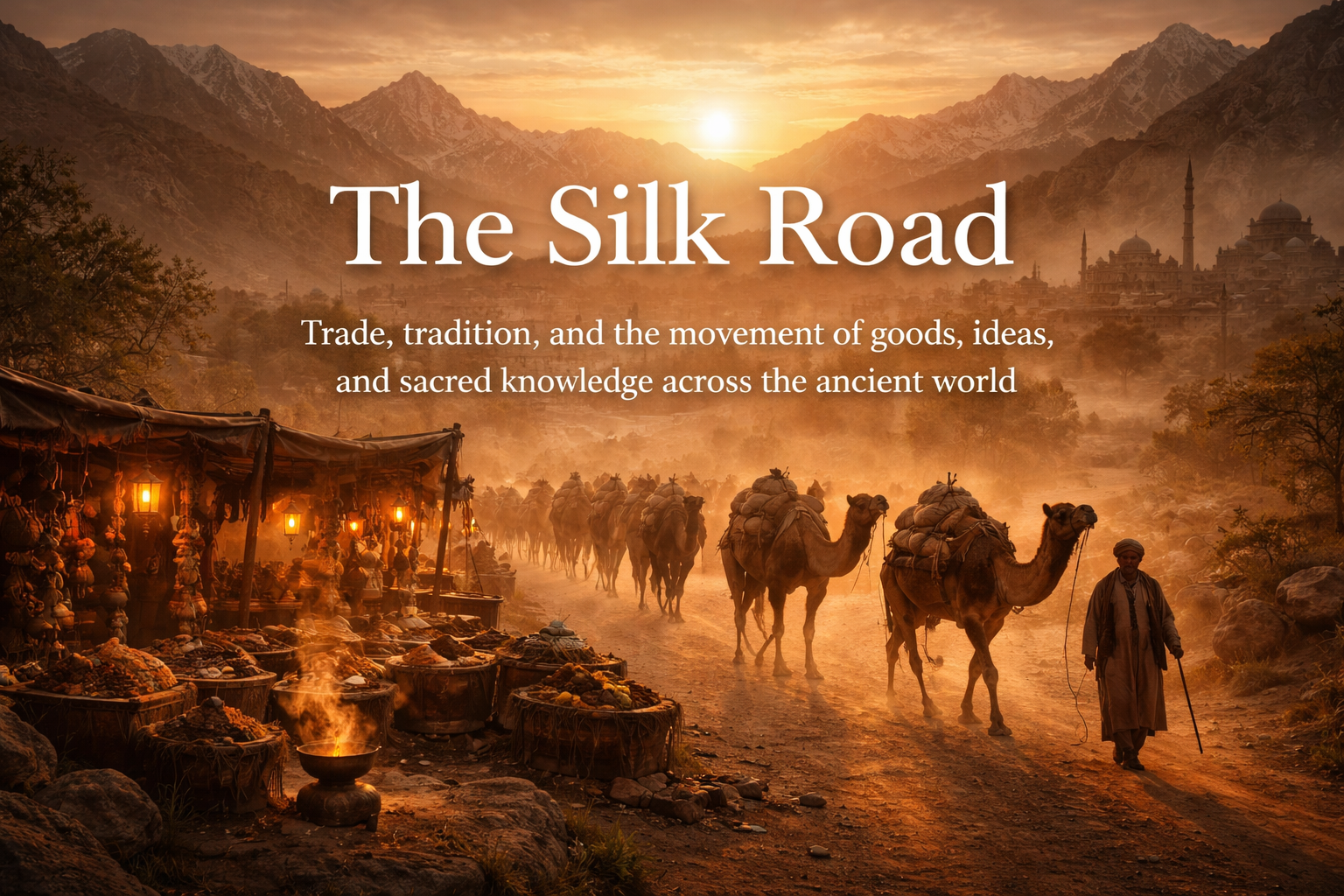
The Silk Road
Trade, tradition, and the movement of goods, ideas, and sacred knowledge across the ancient world
The Living Road
Across deserts, mountains, and shifting empires, the Silk Road was never a single path, but a living network of movement. Caravans carried silk and spice, but also stories, beliefs, remedies, and ways of living. Along these routes, the rhythms of daily life—food, medicine, ritual, and philosophy—were exchanged, adapted, and woven into cultures that continue to shape the modern world.
What emerged was not simply trade, but transformation. Each journey reshaped what was carried, and each destination reinterpreted what arrived.
A Network, Not a Road
The Silk Road was not one road, but many.
From the ancient capital of Chang’an (modern Xi’an), routes stretched westward across the deserts of Central Asia, through mountain passes and fertile valleys, connecting China to India, Persia, and the Mediterranean. Northern paths crossed the steppe; southern routes wound along the edges of the Himalayas. Maritime routes extended these exchanges across seas, linking ports from Southeast Asia to the Middle East.
These routes shifted constantly. Political borders changed, climates fluctuated, and traders adapted. What remained constant was movement—of goods, of people, and of knowledge.
Trade and Material Exchange
The Silk Road is often remembered for its goods. Yet even these material exchanges carried deeper meaning.
Silk was more than luxury—it was identity, diplomacy, and power. Its production was closely guarded, its movement controlled, and its presence symbolic of connection between distant worlds.
Tea began as a regional practice and gradually became a cultural bridge. Carried along trade routes, it transformed from a local ritual into a global tradition.
Spices and aromatics—ginger, cinnamon, star anise, and pepper—traveled vast distances, not only enhancing flavor but shaping regional cuisines and medicinal practices.
Ceramics, metalwork, and textiles reflected artistry in motion. Designs, techniques, and symbols evolved as they passed from one culture to another.
Horses and tools enabled the movement itself, supporting both trade and the expansion of empires.
Each object carried not only utility or value, but traces of the people and places it had passed through.
“The Silk Road was not a road, but a living network of movement.”
Medicine, Herbs, and the Tao of Balance
Along the Silk Road, the boundary between food and medicine was never fixed.
Herbs, roots, and tonics traveled alongside trade goods, carrying with them systems of understanding about the body, health, and balance. Knowledge was exchanged not in isolation, but through practice—through shared meals, remedies, and lived experience.
Ingredients such as ginger, widely used across regions, served both culinary and medicinal purposes. Teas and herbal infusions became daily rituals, offering warmth, restoration, and equilibrium.
Within Chinese traditions, these practices aligned with principles of balance—warming and cooling, nourishing and dispersing. While different cultures described health in different ways, a shared understanding emerged: that well-being depended on harmony within the body and with the surrounding environment.
These ideas continue to live on today, quietly embedded in kitchens, markets, and households around the world.
Sacred Exchange: Religion and Philosophy
Trade routes also carried beliefs.
Buddhism traveled from India into China, moving along the Silk Road through monasteries, caves, and teaching centers. Along the way, it encountered and adapted to existing traditions, including Taoist thought.
This was not a replacement, but a conversation.
Philosophies evolved as they met new landscapes and cultures. Rituals were reshaped. Symbols were reinterpreted. Sacred spaces emerged along trade routes, offering refuge to travelers and serving as centers of learning and devotion.
Temples, mountain sanctuaries, and pilgrimage routes became part of the Silk Road’s living fabric—places where the material and the spiritual met.
Foodways and Daily Life
If trade routes carried goods and ideas, they also carried daily life.
Markets became spaces of cultural exchange, where ingredients, techniques, and tastes mingled. Cooking methods adapted as new tools and foods became available. Recipes evolved across regions, shaped by both necessity and creativity.
Tea culture spread and transformed, becoming central to daily life in multiple societies. Ingredients once foreign became familiar. Local traditions absorbed distant influences.
What people ate—and how they prepared it—became a reflection of movement and connection.
The Silk Road did not just influence cuisine; it shaped how people nourished themselves, gathered, and lived.
Geography and the Shape of Culture
The Silk Road was defined as much by landscape as by people.
Deserts demanded endurance and planning. Mountains created both barriers and sanctuaries. Oases became vital points of rest and exchange.
These environments shaped not only routes, but cultures. They influenced architecture, clothing, diet, and spiritual practice. In many regions, mountains became sacred, embodying both physical challenge and spiritual ascent.
The land itself became part of the story—guiding movement, shaping belief, and anchoring tradition.
The Living Legacy
The Silk Road has never truly disappeared.
Its influence remains in the foods we eat, the medicines we use, the patterns we recognize, and the ideas we inherit. It lives in the blending of cultures, in shared traditions, and in the continued movement of goods and knowledge across the world.
Every cup of tea, every use of spice, every herbal remedy carries echoes of these ancient exchanges.
What began as a network of trade routes became something far greater—a flow of civilization itself.
Closing Reflection
The Silk Road was not defined by distance, but by connection.
It reminds us that culture is not fixed, but shaped through movement, encounter, and exchange. That the boundaries between regions, traditions, and ways of life are often more fluid than they appear.
And that in both grand journeys and daily rituals, we continue to participate in the same flow—one that has been unfolding for centuries.
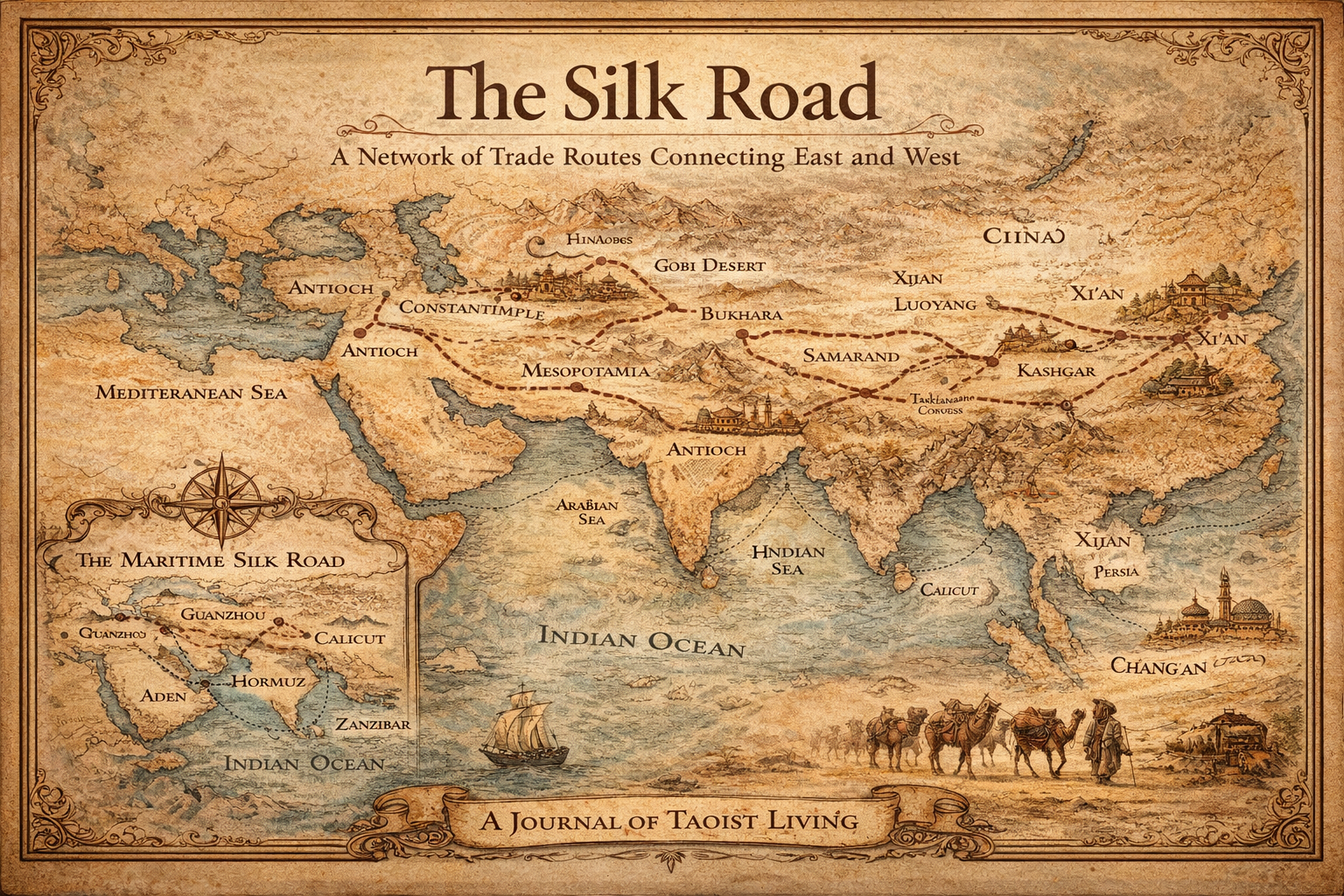
Beyond Land: The Maritime Silk Road
In addition to overland routes, maritime pathways connected ports across Southeast Asia, India, Arabia, and East Africa. These sea routes carried goods, cultures, and technologies across vast distances, expanding the reach of Silk Road exchange far beyond the desert and mountain paths

BHerbs Of The Silk Road
🌱 Ginger (Zingiber officinale)
Warming • Circulating • Restorative
Used across Asia and beyond, ginger was one of the most widely traded roots along the Silk Road. Valued for its warming properties, it supported digestion, circulation, and resilience against cold climates.
👉 Connects to:
Taoist Kitchen Traditions + Remedies
🌿 Ginseng (Panax ginseng)
Vitality • Strength • Longevity
Highly prized and often reserved for elites, ginseng symbolized vitality and endurance. It traveled as a medicinal treasure, believed to restore energy and balance the body.
👉 Connects to:
Longevity + Taoist philosophy
🍒 Goji Berry (Lycium barbarum)
Nourishing • Brightening • Balancing
These small, vibrant berries became a staple in both food and medicine. Known for supporting overall vitality, they were often used in teas, broths, and tonics.
👉 Connects to:
Daily nourishment + balance
🍵 Green Tea (Camellia sinensis)
Calming • Clarifying • Centering
Carried along trade routes and adopted across cultures, green tea became more than a beverage—it became ritual. It offered both physical refreshment and mental clarity.
👉 Connects to:
Tea culture + daily practice
These ingredients were not merely traded—they were lived with, prepared, and passed down through generations, becoming part of everyday balance and well-being.